Snapshots of IM Residency Program Director Subspecialty Training and Graduate Type
November 2025
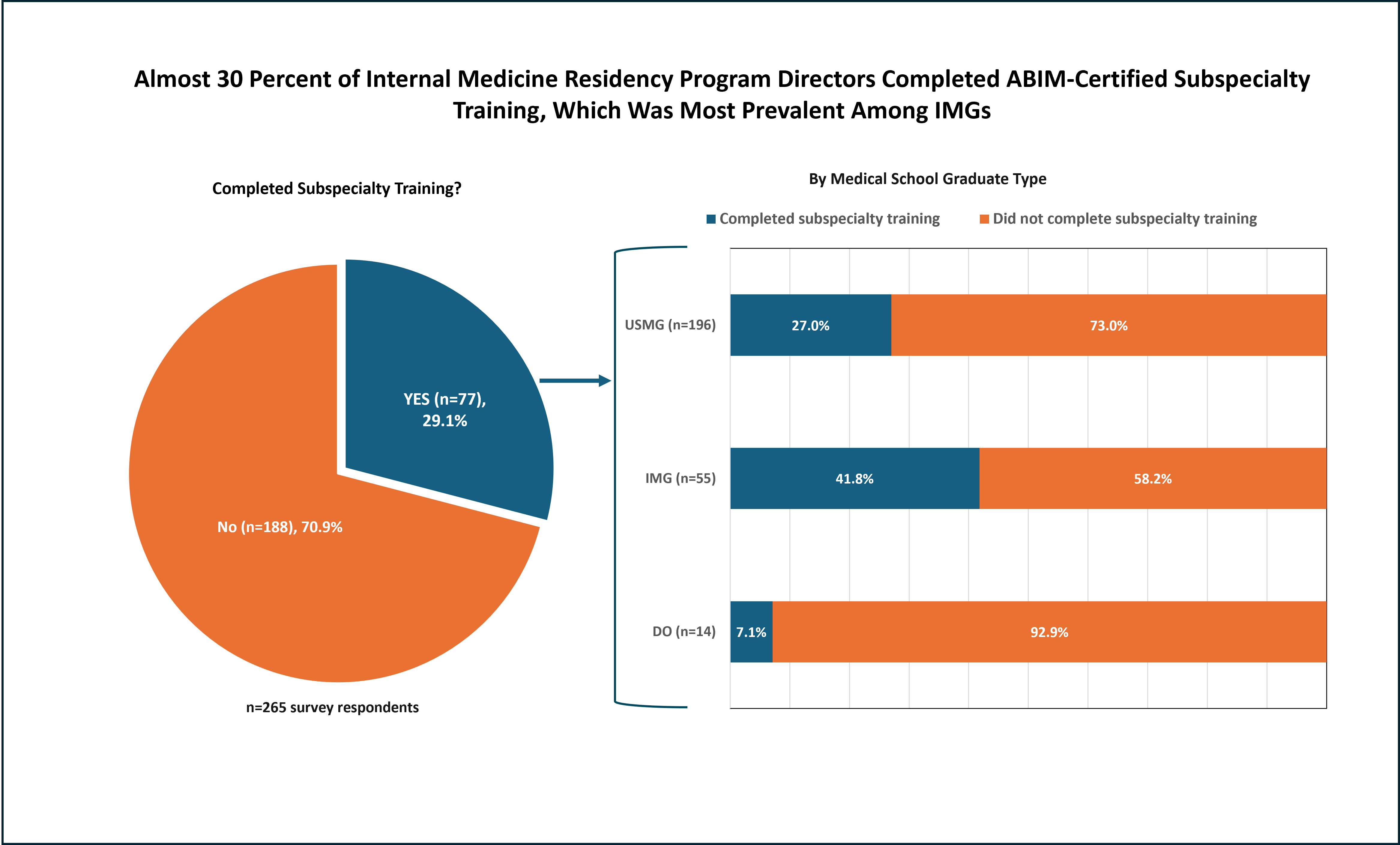
Almost 30 Percent of Internal Medicine Residency Program Directors Completed ABIM-Certified Subspecialty Training, Which Was Most Prevalent Among IMGs
Source: 2024 APDIM Annual Survey of IM Residency PDs
Notes:
- USMG: Graduate of a U.S. or Canadian allopathic medical school, accredited by the LCME
- IMG: Graduate of a medical school outside the United States and Canada, not accredited by the LCME
- DO: U.S. or Canadian osteopathic medical school graduate
- ABIM: American Board of Internal Medicine
Adjusted Wald (Pearson) Chi-Square test of association with one degree of freedom for all comparisons between each graduate type and whether subspecialty training was completed: p<0.05 or p<0.01.
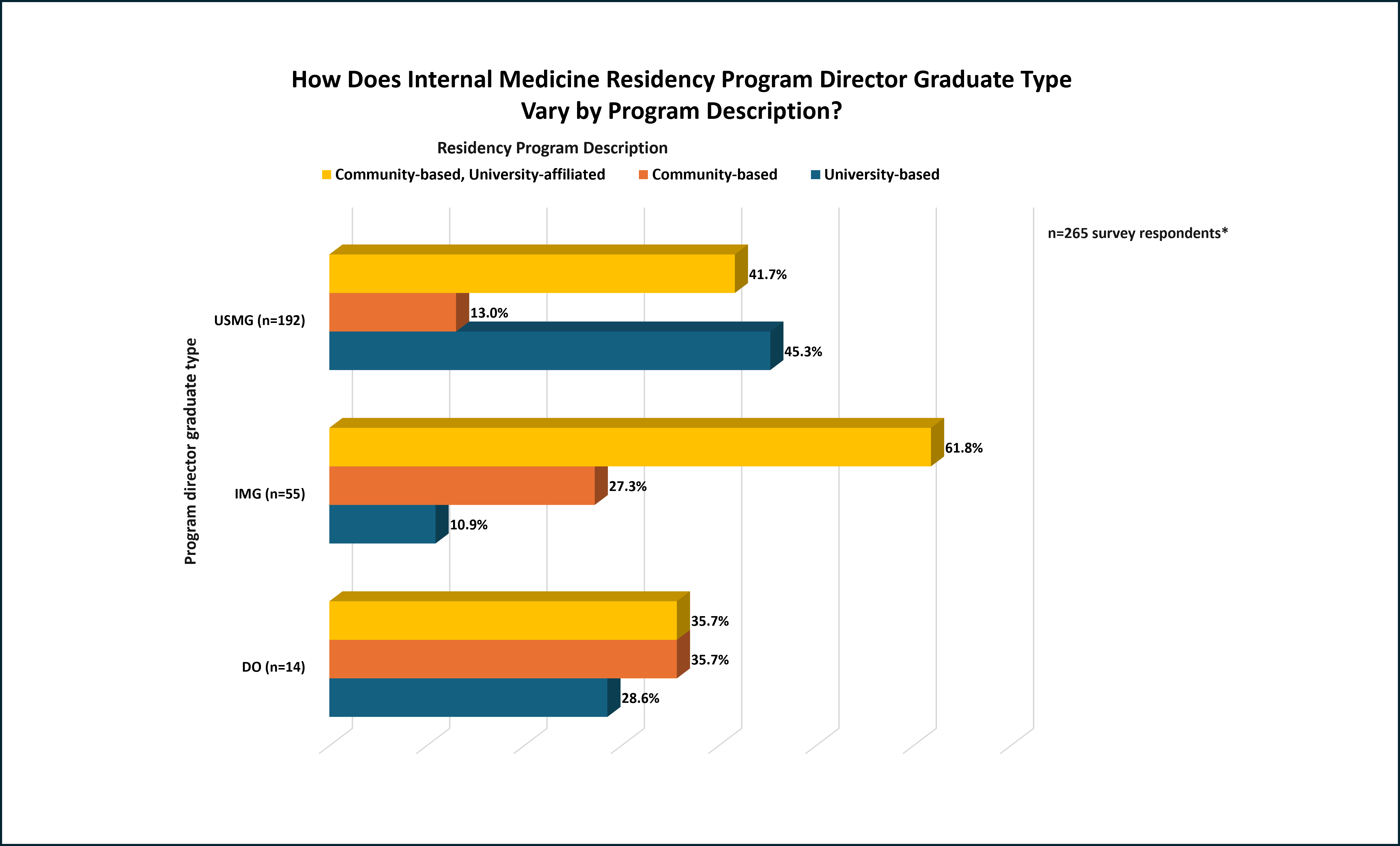
How Does Internal Medicine Residency Program Director Graduate Type Vary by Program Description?
Source: 2024 APDIM Annual Survey of IM Residency PDs
Notes:
- USMG: Graduate of a U.S. or Canadian allopathic medical school, accredited by the LCME
- IMG: Graduate of a medical school outside the United States and Canada, not accredited by the LCME
- DO: U.S. or Canadian osteopathic medical school graduate
Residency program type obtained through AMA-FREIDA Online®: AMA Residency & Fellowship Database®.
Adjusted Wald (Pearson) Chi-Square test of association with one degree of freedom for all comparisons between graduate type “USMG or IMG” and program description: p<0.05 or p<0.01.
This month’s Data in Brief compares internal medicine (IM) residency program director (PD) medical school graduate type by subspecialty training and program description, based on the 2024 APDIM Annual Survey of IM Residency PDs. Overall, almost 30% of IM PDs completed ABIM-certified subspecialty training. Among international medical graduates (IMGs), 42% were subspecialty-certified, compared to 27% of U.S. medical graduates (USMGs) and 7% of doctors of osteopathy (DOs). Almost 90% of IMG PDs were located at community-based or community-based, university-affiliated programs, compared to 55% of USMGs and 71% of DOs.
For more information or if you have questions about these findings, please contact surveys@im.org.
Download onlyPrivacy Policy |
Terms of Use |
Contact Us
330 John Carlyle Street | Suite 610 | Alexandria, VA 22314 | P: (703) 341-4540
© Alliance for Academic Internal Medicine. All Rights Reserved.
Web Design & Development by Matrix Group International, Inc.
.tmb-medium.png?Culture=en&sfvrsn=44351355_1 "even-better-together-w-swirl-(alt)")