Burnout Remains the Strongest Predictor of Training Program Administrator Consideration of Resigning
September 2025
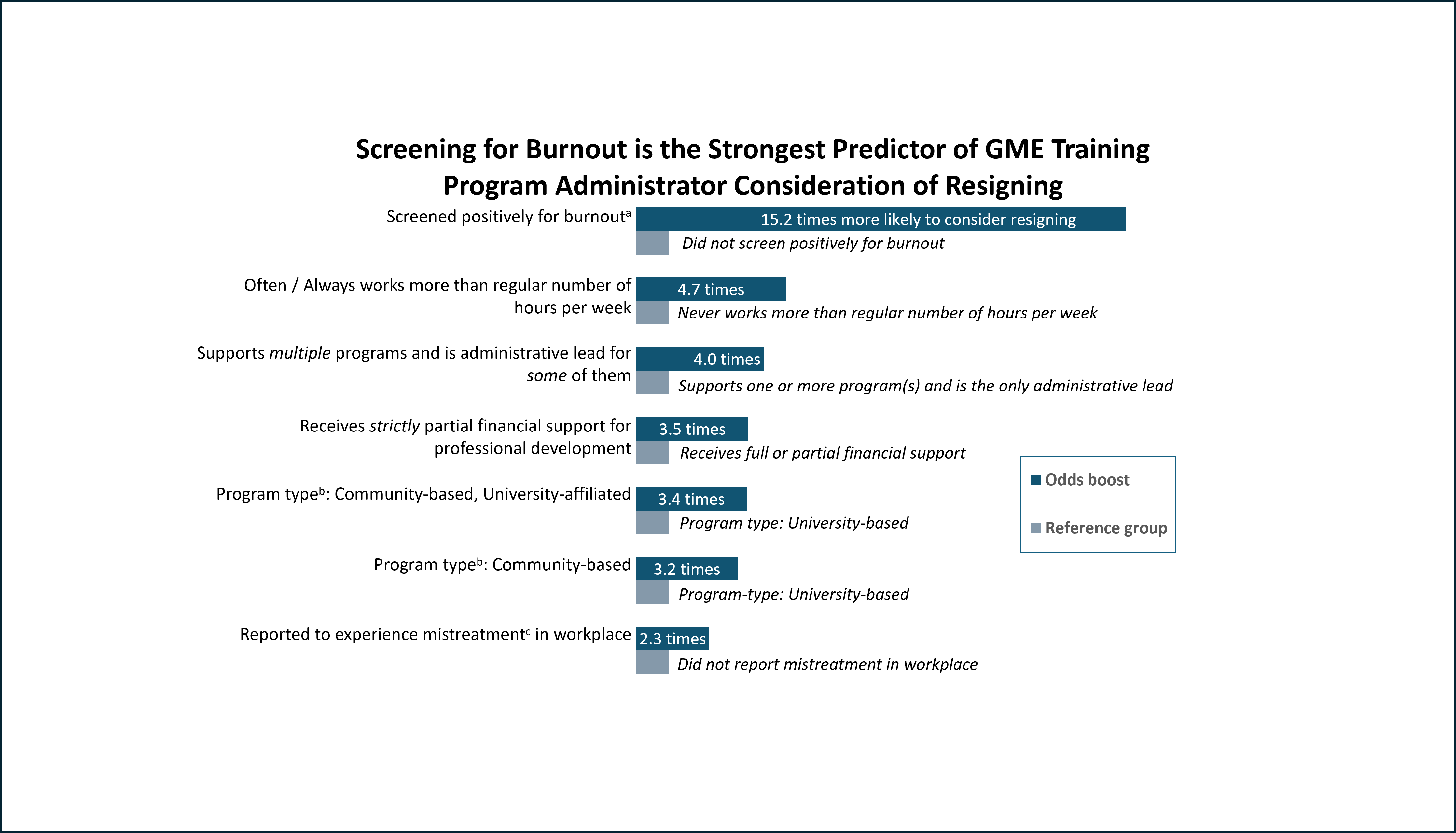
Screening for Burnout is the Strongest Predictor of GME Training Program Administrator Consideration of Resigning
Source:
2025 APDIM Internal Medicine Residency and Fellowship Program Administration Annual Survey
Notes: Results were statistically weight-adjusted to more closely represent the total survey population of 908; 384 of 410 respondents answered the question, “In the past year, have you considered resigning from your position?”
Model description and supporting results: Weighted logistic regression with linearized standard error, controlling for institutional resource capacity using AAIM membership database organizational dues classification as the offset variable. Wald Chi-Square (39 degrees of freedom): p<0.001; Pseudo R-squared: 0.30. Characteristics in the figure above represent those that demonstrated statistical significance at p<0.05.
aPositive screen for burnout derived from Maslach, Christina and Susan E. Jackson. 1981. MBI-Human Services Survey. Published by Mind Garden, Inc., www.mindgarden.com. bProgram type obtained from AMA-FREIDA Online®: AMA Residency & Fellowship Database®. c“Mistreatment” in the workplace was defined as “Any behavior that disrespects others or interferes with work.”
This month's Data in Brief explores what predicts GME residency and fellowship training program administrator (PA) consideration of resigning, based on the 2025 APDIM Internal Medicine Residency and Fellowship PA Annual Survey. PAs who reported to work “always” or “often” beyond the regular number of hours for their position were about 4.7 times more likely to consider resigning than those who never worked beyond regular hours. However, screening for burnout was the strongest predictor of consideration to resign: PAs who screened positively were about 15 times more likely to consider resigning, underscoring the effect of burnout in the workplace.
Download onlyPrivacy Policy |
Terms of Use |
Contact Us
330 John Carlyle Street | Suite 610 | Alexandria, VA 22314 | P: (703) 341-4540
© Alliance for Academic Internal Medicine. All Rights Reserved.
Web Design & Development by Matrix Group International, Inc.
.tmb-medium.png?Culture=en&sfvrsn=44351355_1 "even-better-together-w-swirl-(alt)")